Find your next favorite work.

[Chu A-young’s Music Box] The Music of ‘Chiikawa the Movie’ Sings of Tragedy From Opposite Sides

I find myself drawn to music in movies. Sometimes music reveals a character’s private feelings that images and dialogue alone cannot fully convey. It can also offer a window into a creator’s hidden intentions. For me, understanding a film’s music has been one way to reach the film itself. ‘Chu A-young’s Music Box’ listens more closely to a film’s voice through its music. (P.S. I hope you’ll listen to the music as you read.)

〈Chiikawa the Movie: The Secret of the Mermaid Island〉

Music flows continuously through 〈Chiikawa the Movie: The Secret of the Mermaid Island〉 (hereafter 〈Chiikawa the Movie〉), from the Siren’s enchanting song and a rap featuring Usagi’s distinctive vocal style to the Japanese standard ‘Today, We Say Goodbye’ (Kyou no hi wa sayounara). Each strangely addictive piece stays with viewers long after they leave the theater. In fact, the soundtrack album for 〈Chiikawa the Movie〉 topped Billboard Japan’s overall albums chart in August of this year. It was the first movie soundtrack to reach No. 1 in seven years, since RADWIMPS’ soundtrack for Makoto Shinkai’s 〈Weathering With You〉. In South Korea, too, the music has taken over social media, where it is made into and shared as memes. The music that has captivated audiences is repeated throughout 〈Chiikawa the Movie〉, with different characters performing variations of it in different scenes. Those repetitions and variations hold the secret of Mermaid Island, seemingly bathed in the atmosphere of a fantastical festival.


〈Chiikawa the Movie: The Secret of the Mermaid Island〉

The film’s main theme, ‘The Island Song,’ is sung by various characters, including the islanders, the Siren and Shimajiro, and recurs in several variations. Nagano, the original creator, asked music directors Shugo Tokumaru and Chikara Kamimizutaru to establish the island’s main theme and then arrange versions suited to different situations in the film. As Nagano requested, ‘The Island Song’ functions as a leitmotif: a single melody that takes on different meanings depending on the scene and the character.
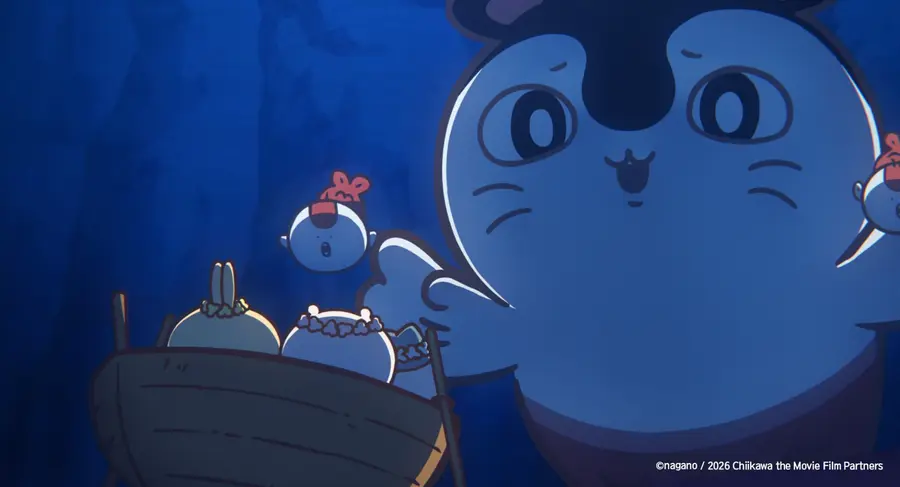
〈Chiikawa the Movie: The Secret of the Mermaid Island〉 The Siren and the mermaids

‘The Island Song’ is first heard when the Chiikawa characters arrive on Mermaid Island, hoping to collect a massive bounty worth 100 times the usual amount for defeating a foe. The music that casts a festive illusion over Mermaid Island underscores music’s important role in ritual. Sung by the island’s inhabitants, it also helps bind the community together. Their voices evoke the abundance and peace of a perfect community. But the song means something different in the Siren’s version. Where three mermaids should be singing in harmony, the Siren’s version lacks the third that would complete the harmony, making its loss audible. It exposes the underside of the seemingly perfect community and turns the pain of loss into anger. At the same time, music that once expressed communal solidarity comes to reveal the threat posed by a being excluded from that community and treated as an outsider. ‘The Island Song’ is thus both an affirmation of the identity shared by the island’s inhabitants and a trace of the violence the community seeks to hide.
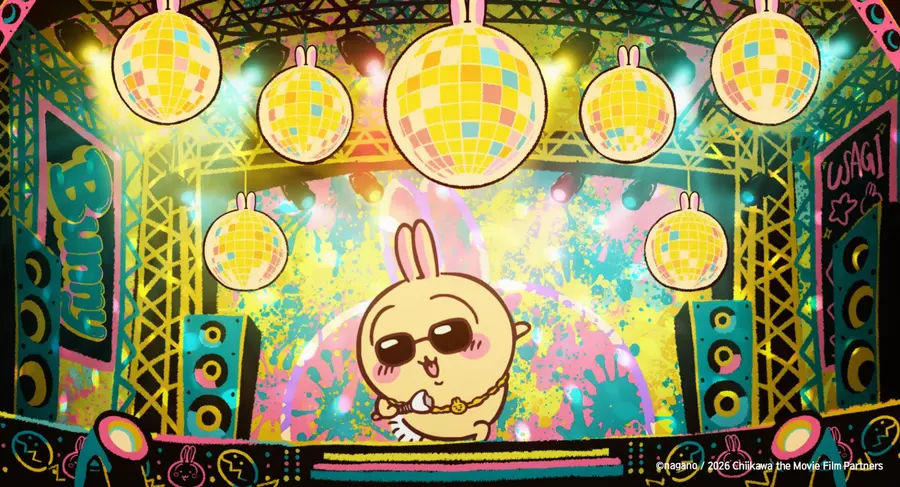
〈Chiikawa the Movie: The Secret of the Mermaid Island〉 Usagi

Usagi counters the Siren’s song, which threatens his friends, with a rap delivered in his distinctive vocal style. His rap temporarily neutralizes the Siren’s powerful song, which shakes the whole of Mermaid Island. Why can Usagi’s rap do this? Hip-hop has long served as the language of a counterculture that challenges established order and authority. In a genre that prizes an individual’s delivery, rhythm and spontaneity over a set melody and harmony, the individual voice comes before group harmony. Hip-hop’s cultural resistance to a community’s prescribed rules takes shape in the spontaneous rhythms and dancing of Usagi, a character whose actions are hard to predict, and throws the Siren’s calculated rules off balance. Before long, even the mermaids serving as the Siren’s chorus forget their roles and begin interjecting along with Usagi’s rap. If the Siren’s song commands the space through melody and harmony, Usagi’s rap emphasizes music’s capacity to break free of ritual and disrupt a controlled world and its rules. Still, Usagi’s defiant rap cannot entirely displace the Siren’s beautifully harmonious song. It does, however, show that music with a different rhythm can be beautiful, too, opening up the possibility of another way of life.


A Sealed Peace That Buries the Truth

〈Chiikawa the Movie: The Secret of the Mermaid Island〉 Chiikawa

The communal culture brought into sharp focus by the music of 〈Chiikawa the Movie〉, along with what lies beneath it, offers a critical view of the ethics of the dominant social setting in Japan and the cultural code known as ‘reading the air.’ “In Japanese society, there is a widespread tacit understanding, among adults and children alike, that people who fail to grasp the mood are looked down on and excluded as ‘KY,’ slang for ‘unable to read the air.’” (See Park Gyu-tae, 「Psychoanalyzing Japan」, Ihaksa, 2018, p. 85.) This Japanese cultural code informs Chiikawa’s decision never to reveal who killed the Siren’s mermaid friend. Though Chiikawa knows the truth, he avoids disclosing it and establishing responsibility. His choice restores a surface calm to the island, but it is closer to a sealed peace that buries the truth forever. “Under the ethics of the social setting, responsibility for a wrongdoing is considered to lie with all members rather than with an individual. Maintaining the equilibrium of the given setting is valued above all else.” (See the same book.) Chiikawa’s decision is a collectivist product of reading the air within those ethics: a choice to put the group’s harmony ahead of uncovering the truth.

〈Chiikawa the Movie: The Secret of the Mermaid Island〉

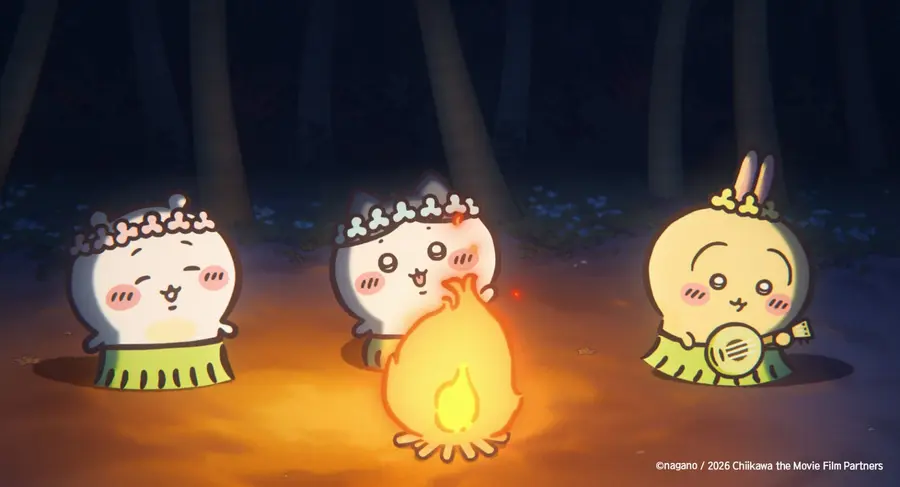
At this point, the islanders and the Chiikawa characters, having regained their peace, sing ‘Today, We Say Goodbye’ (Kyou no hi wa sayounara). The song is first heard in the film from Hachiware, who values his friendships. It returns when Hachiware, Chiikawa and Usagi promise each other eternal friendship beside a campfire, symbolizing their innocent bond. Then it returns as Chiikawa wrestles with his decision and makes his choice, losing its original meaning. Once a song about friendship grounded in trust and the hope of meeting again, it now also exposes the contradiction in Chiikawa’s choice to preserve relationships—in other words, the social setting. The lyric heard in the scene, “Let’s put the joy of trusting one another first,” sounds like an ironic justification for Chiikawa’s decision to conceal the truth in order to protect the community’s harmony and its relationships. Here, Hachiware’s innocence becomes the ignorance of someone unaware of the community’s underside and the truth, while Chiikawa becomes someone who has lost the innocence with which he pledged eternal friendship alongside Hachiware. The song’s lyricism makes the distance between the two characters all the more tragic. For Hachiware, it signifies the hope of eternal friendship and reunion; for Chiikawa, it is the weight of a truth he bears alone.

[Chua-young's Music Box] The Meta Representation of Subculture 'Cosmic Princess Kaguya!' with 'World Is Mine' and 'Reply'

[Chua-young's Music Box] The Meta Representation of Subculture 'Cosmic Princess Kaguya!' with 'World Is Mine' and 'Reply'

I get hooked on the music in movies. Music sometimes conveys the intimate emotions of characters that cannot be expressed through visible images and audible dialogues. It can also serve as a window to glimpse the hidden intentions of the creator. For me, understanding movie music was one way to connect with the film. 'Chua-young's Music Box' listens to the voice of the movie more closely through music. (P.S. I hope you read this while listening to the music.)

[Chu Ah-young's Music Box] Michael Jackson's 'Thriller' and 'Heal the World' That Tried to Turn Dreams into Reality

[Chu Ah-young's Music Box] Michael Jackson's 'Thriller' and 'Heal the World' That Tried to Turn Dreams into Reality

I am captivated by music in films. Music sometimes reveals a character's intimate emotions that visible images and spoken lines alone cannot convey. It can become a window into the creator's hidden intentions. For me, understanding film music was one way of reaching a movie. 'Chu Ah-young's Music Box' listens to a film's voice up close by way of its music. (P.S. I hope you listen to the music while reading.)

[Choo A-young’s Music Box] After Anger, ‘Oasis: Don’t Look Back in Anger’ Sings Again

[Choo A-young’s Music Box] After Anger, ‘Oasis: Don’t Look Back in Anger’ Sings Again

[Chua-Young’s Music Box] ‘Project Hail Mary’—A Story of Humanity’s Trembling at the Brink of the End, and ‘Sign of the Times’

[Chua-Young’s Music Box] ‘Project Hail Mary’—A Story of Humanity’s Trembling at the Brink of the End, and ‘Sign of the Times’

[Chua-young's Music Box] The Screams of 'The Shining', the Auditory Discomfort Created by Krzysztof Penderecki's Music

[Chua-young's Music Box] The Screams of 'The Shining', the Auditory Discomfort Created by Krzysztof Penderecki's Music

I get hooked on the music in movies. Music sometimes conveys the intimate emotions of characters that cannot be fully expressed through visible images and audible dialogues. It can also serve as a window to glimpse the hidden intentions of the creator. For me, understanding film music was one way to connect with the film. 'Chua-young's Music Box' listens to the voice of the film more closely through music. (P.S. I hope you read this while listening to the music.)

[Chua-young's Music Box] Why Did 'What If We' Resonate with Today's Youth? The Romance Fantasy of the Non-Dating Generation

[Chua-young's Music Box] Why Did 'What If We' Resonate with Today's Youth? The Romance Fantasy of the Non-Dating Generation

I am captivated by the music in movies. Music sometimes conveys the intimate emotions of characters that cannot be expressed through visible images and audible dialogues alone. It can also serve as a window into the hidden intentions of the creator. For me, understanding movie music was one way to connect with the film. 'Chua-young's Music Box' listens to the voice of the movie more closely through music. (P.S. I hope you read this while listening to the music.)

Choo A-young's Music Box: Steven Spielberg and John Williams Reunite for Their 30th Film, 〈Disclosure Day〉

Choo A-young's Music Box: Steven Spielberg and John Williams Reunite for Their 30th Film, 〈Disclosure Day〉

[Chua-young's Music Box] The Music of 'Pavane' Following the Path of Love

[Chua-young's Music Box] The Music of 'Pavane' Following the Path of Love

I am captivated by the music in movies. Music sometimes conveys the intimate emotions of characters that cannot be expressed through visible images and audible dialogues. It can also serve as a window into the hidden intentions of the creator. For me, understanding film music was one way to connect with the film. 'Chua-young's Music Box' listens to the voice of the film more closely through music. (P.S. I hope you read this while listening to the music.)

[Choo Ah-young’s Music Box] Magical Moments Made from Clashing Images and Sound in ‘Heaven Knows What’

[Choo Ah-young’s Music Box] Magical Moments Made from Clashing Images and Sound in ‘Heaven Knows What’

[Chua-Young’s Music Box] Music for the Purification Ritual of Wounded Youth: “Girls Band Cry”

[Chua-Young’s Music Box] Music for the Purification Ritual of Wounded Youth: “Girls Band Cry”

I get hooked on the music in the film. Music sometimes conveys intimate feelings a character can’t fully express through the visuals alone—or through the lines you hear. It can also serve as a window into the creator’s hidden intentions. For me, understanding film music was one way to connect with the movie. “Chua-Young’s Music Box” lets you listen more closely to the movie’s voice through music. (P.S. While listening to the music, I hope you’ll read the article.)

[Chua-young's Music Box] May Madness Reign on This Land! '28 Years Later: The Bone Temple' and 'The Number of the Beast'

[Chua-young's Music Box] May Madness Reign on This Land! '28 Years Later: The Bone Temple' and 'The Number of the Beast'

I am captivated by the music in movies. Music sometimes conveys the intimate emotions of characters that cannot be expressed through visible images and audible dialogues alone. It can also serve as a window into the hidden intentions of the creator. For me, understanding film music was one way to connect with the film. 'Chua-young's Music Box' listens to the voice of the film more closely through music. (P.S. I hope you read this while listening to the music.)

In 'Odyssey,' Music Maps Odysseus' Shattered Inner Life

In 'Odyssey,' Music Maps Odysseus' Shattered Inner Life

Choo Ah-young's Music Box: How 'Marty Supreme' and 1980s New Wave Lay Bare Capitalism's Script

Choo Ah-young's Music Box: How 'Marty Supreme' and 1980s New Wave Lay Bare Capitalism's Script

[Chua-young's Music Box] The Coexistence of Sorrow and Hope 'Super Happy Forever' and 'Beyond The Sea'

[Chua-young's Music Box] The Coexistence of Sorrow and Hope 'Super Happy Forever' and 'Beyond The Sea'

I am captivated by the music in movies. Music sometimes conveys the intimate emotions of characters that cannot be expressed through visible images and audible dialogues alone. It can also serve as a window to glimpse the hidden intentions of the creator. For me, understanding film music was one way to connect with the film. 'Chua-young's Music Box' listens to the voice of the film more closely through music. (P.S. I hope you read this while listening to the music.)

×

댓글 (0)

아직 댓글이 없습니다. 첫 댓글을 작성해보세요!

댓글 작성