




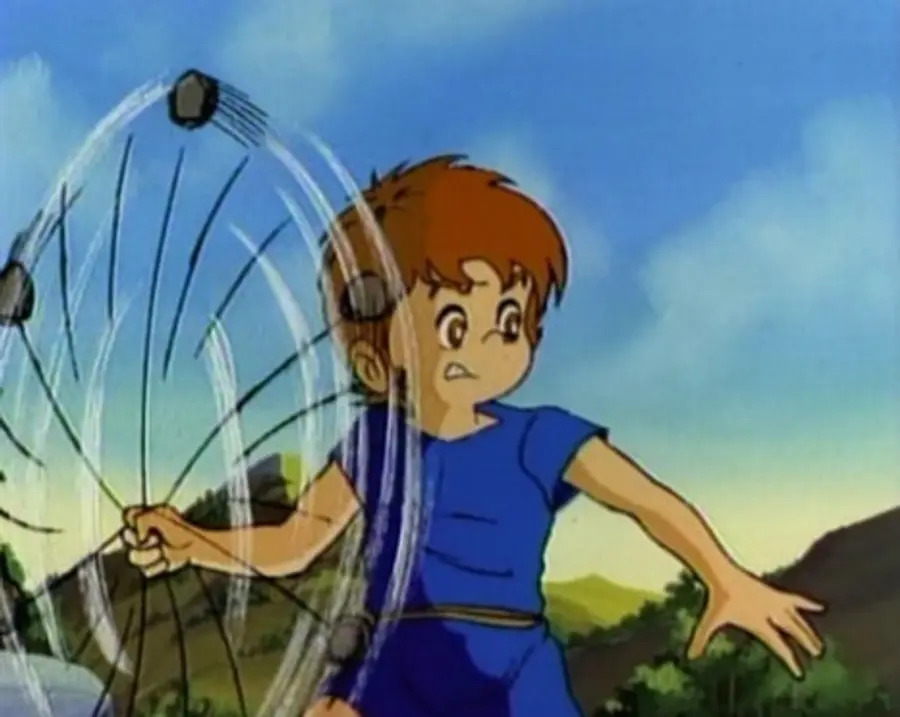
Is there anyone who doesn’t know David’s stone? The story of David and Goliath that is told in 〈Robot Taekwon V〉(1976), and 〈General Tolly〉, and the 〈Ureomei〉 series, and countless other children’s animations and feature films—was also made by director Kim Cheong-gi, known for creating them all. The Korean animation 〈David and Goliath〉(1983) was also made. It is an underdog victory narrative so familiar that anyone can recognize it, even if they are not religious, and it lands somewhere beyond the boundaries of the Bible.
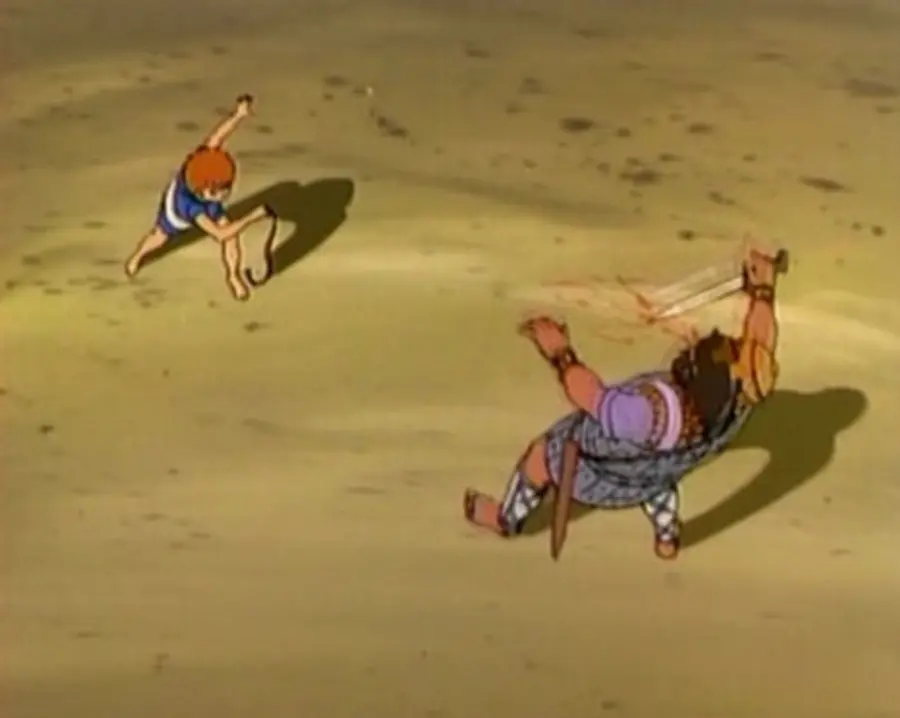
When the shepherd boy David sees that the sheep are in danger, he saves them from a wolf by hurling stones. From then on, David begins practicing with his sling. Before long, David becomes an expert; he further hones his skills by rescuing Mika in danger from a lion. At the time, the people of Israel had crowned Saul, whom God had chosen, as king and expanded the kingdom’s territory, but Saul gradually satisfies only his own desires. Disappointed, the prophet Samuel warns Saul. Then, according to God’s revelation that among the five sons of Jesse there would be a king for the people of Judah, he brings young David to Saul’s palace. Israel was at that moment under invasion by the Philistines, and the Philistine giant Goliath was a figure of terror for the Jewish people. Unable to bear it any longer, David defeats Goliath in a one-on-one showdown—fighting only with a sling and nothing else.
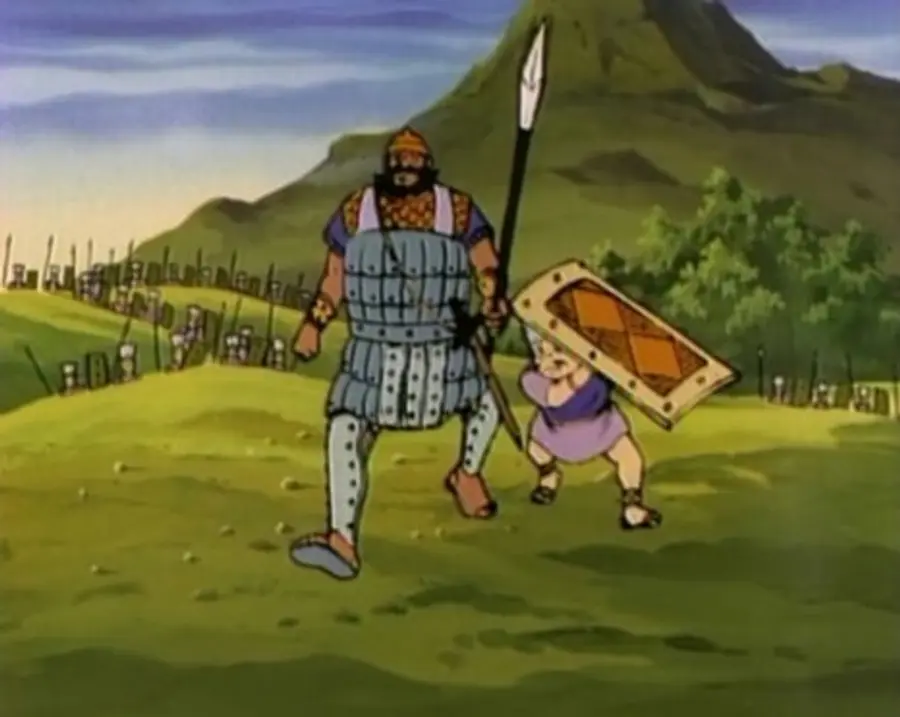
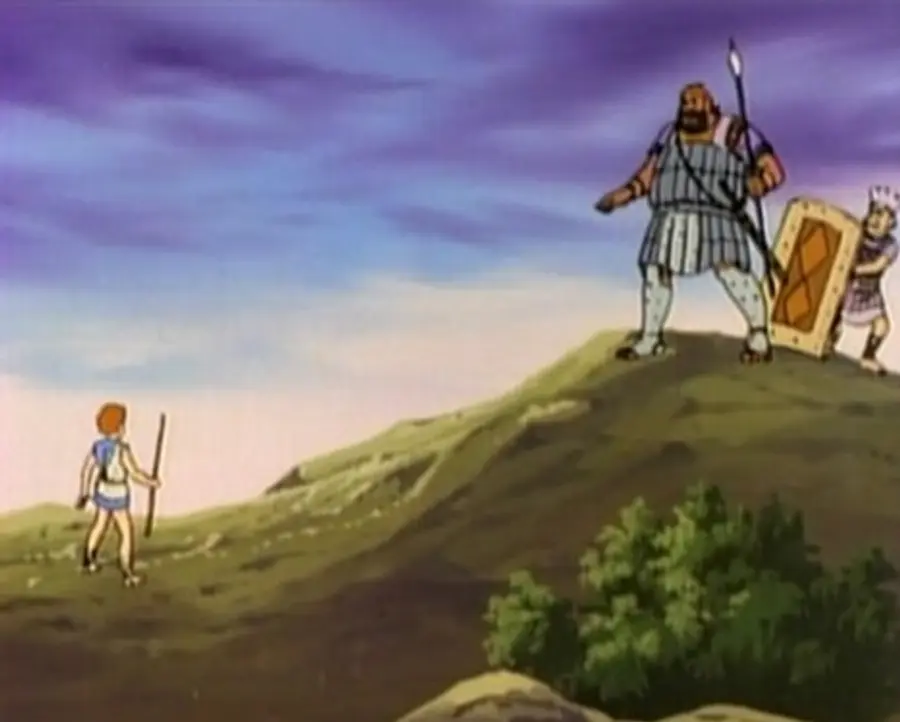
In addition to the works mentioned above, director Kim Cheong-gi also made 〈Go Uyoung’s Three Kingdoms〉(1980) as an animation series, and turned somewhere-familiar stories into animation beyond genres and borders—such as 〈Dinosaur Million Years Tolly〉(1981) and 〈The Rogue Im Gyeok-jeong〉(1997). 〈David and Goliath〉 can be said to be an extension of that line. He also made 〈Queen Esther〉(1996), which portrays the story of the Jewish queen Esther, a native of Judah, who saved Jews facing the threat of annihilation after being taken captive to Babylon. Among those works, 〈David and Goliath__ can be said to be close to action animation in its own right: it meticulously depicts the process from training with the sling until completion. After fighting a wolf and building up his physical strength, David also fights a lion, and that ultimately serves as a buildup toward the final confrontation with the giant Goliath. In the previously released 〈General Tolly’s Episode 3: The Third Tunnels〉(1979), where a final villain—North Korean leader Kim Il-sung—was imaged as a red pig, the Goliath of 〈David and Goliath〉 was, at the time, also like a signature representing a massive “evil.”
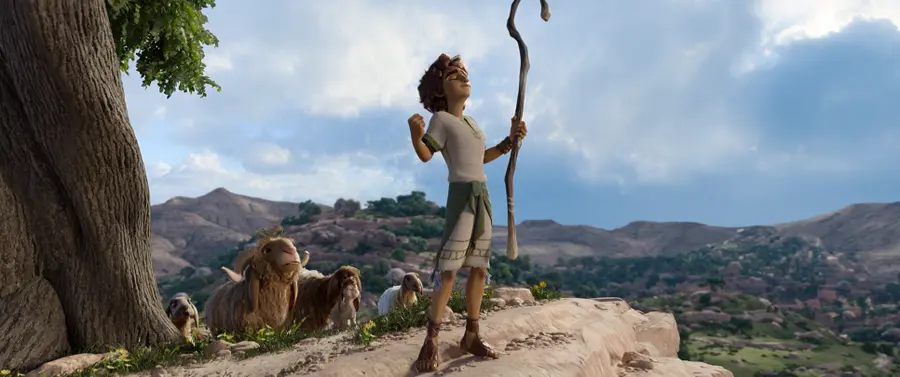
The victory narrative and the heroic storyline that David’s sling brings about are too famous to call a spoiler. The plot of director Kim Cheong-gi’s 〈David’s Goliath〉—mentioned earlier—was the core thread of nearly all “David and Goliath” content, ranging from movies and animations based on it to TV series. It was also an unchanging rule that the victory David wins is placed at the climax. That is why it is especially meaningful that the recently released 〈David〉 by filmmaker Phil Cunningham and director Brent Dos chose to title the film as simply 〈David〉 after dropping “Goliath,” rather than keeping the famous pairing in the title. The meaning is that they will tie up the famous showdown between David and Goliath early and then focus on David’s life and story afterward. Whether that strategy paid off or not, 〈David〉 crossed $60 million in its opening week and set the highest opening score of all time for religious films at the North American box office. It also surpassed the opening box-office record of director Jang Seong-ho’s Korean animation 〈King of Kings〉(2025), which had previously held the top North American box office record among Korean films—〈Parasite〉(2019).
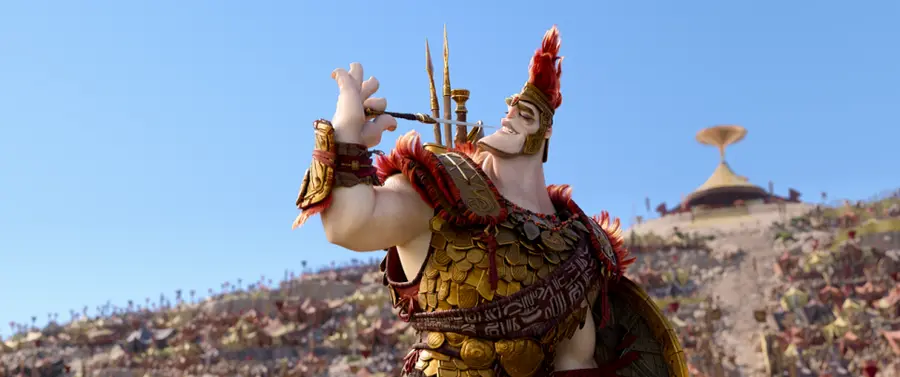
The production period for 〈David and Goliath〉 took as long as 10 years. Cunningham and Brent Dos, who previously handled producing and writing for 〈Judah’s Lion: Easter Adventure〉(2011), met again as co-directors for this project—but after that work, they devoted themselves only to 〈David〉. They reflected with care not only records of clothing and weapons, armor, armies and battles, but also details about major figures from the Bible. For parts where no materials remained, they expanded the scope based on the historical and cultural context of the ancient Near East. Consultants from world-class experts were added to raise the academic finish, including Dr. Douglas Petrovich, an author and historian, and Rabbi Tully Weiss, a specialist in ancient Hebrew. In particular, they implemented every letter appearing on film elements such as flags, maps, and pottery fragments in actual ancient Hebrew, leaving nothing out—even down to the fine details—so they could build a living, breathing historical world. They also visited real locations such as Bethlehem and the Elah Valley multiple times, recording everything from terrain and natural environment to changes in light and seasons, and then infused it into the visuals. Of course, they also collected a variety of real natural sounds on location, from wind and thunder to the cries of birds that fill the air. It’s a global project completed together by 400 artists gathered from 32 countries around the world.
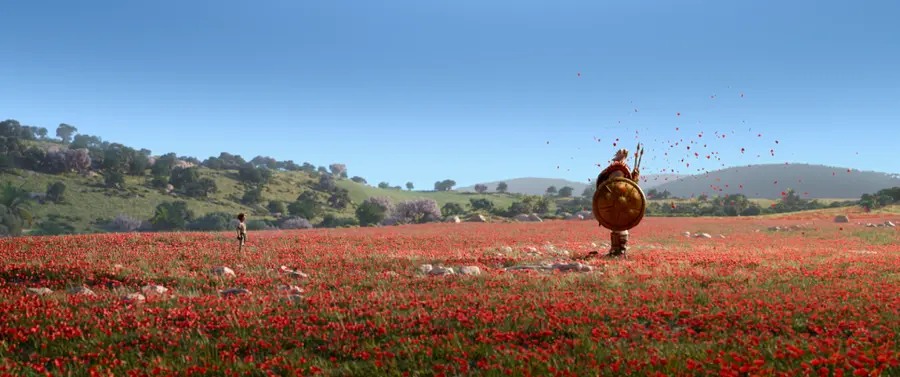
At last, in the showdown scene between David and Goliath, the production used stones collected from the Elah Valley, the historical backdrop of the story. Astonishingly, the sound was recorded on location, all the way from the moment David’s thrown stone takes flight to the moment it collides. Surely stones used for slings differ somewhere in the world—so what’s the difference, really? They made the sound using the actual stones from that place. And even though it’s animation and the team couldn’t show those stones directly, the crew went ahead anyway. They challenged the approach of not treating the duel as a climax, but they wanted to make sure not to forget the symbolism carried by that scene. Beyond that, they didn’t rely on any special tricks. For filming, they chose a method focused on the story and the characters rather than flashy techniques. They also avoided excessive direction, tempering camera movement, lighting, and screen composition as much as possible so viewers’ attention could naturally stay with the characters’ emotions and relationships—and with the vast landscapes. That is exactly why the production minimized overly strong lens effects and artificial camera motion when David and Goliath face each other. In the end, they created a heavy sense of realism, as if the two stood together in an actual historical space.
* An overabundance of meaning given to objects in movies—starting with the actor’s wish-list “Joo Seong-cheol’s Locker,” which kicks off hopes for a rise in fortune; the actor’s usage guide for “Kim Ji-yeon’s Jewel Box”; the film-music listening room “Chua Young’s Music Box,” where my heart gets moved; and even “Sungchan Eul’s Comic Books,” a purchase log by a mere subculture busybody—Cineplay reporters begin their every-other-week series with each of them bringing their own tastes and viewpoints.
![[Joo Seong-cheol's Locker] The Black Speaker of 'Sirat' and the Monolith of '2001: A Space Odyssey'](https://cdn.www.cineplay.co.kr/w400/q75/article-images/2026-02-23/01816f3a-b433-4072-887b-e760357e6cc7.jpg)
![[Joo Seong-cheol's Locker] The 'Canned Cart Camera' that Changed the History of World Cinema with 'Nouvelle Vague'](https://cdn.www.cineplay.co.kr/w400/q75/article-images/2026-01-27/563f1a4c-20b8-460b-8523-f31511911bd5.jpg)
![[Joo Sung-cheol's Locker] Ahn Sung-ki is Born, I am Ahn Sung-ki](https://cdn.www.cineplay.co.kr/w400/q75/article-images/2026-01-13/362be897-34af-4524-9a57-6b9935666a0a.jpg)
![[Jusungcheol’s Locker] Odyssey’s one-eyed giant Cyclops and Ray Harryhausen’s “The Seventh Voyage of Sinbad”](https://cdn.www.cineplay.co.kr/w400/q75/article-images/2026-08-10/5faf400e-cf0b-466c-a3d7-31a8bbb38075.jpg)
![[Joo Seong-cheol’s Locker] See ‘Hope’ Again Through the Driver-Grade Cap Joo Seong-cheol Wears While Racing Across Seong-gi Bridge in ‘The Yellow Sea’ and ‘Goksung’](https://cdn.www.cineplay.co.kr/w400/q75/article-images/2026-07-28/7bf74e36-337d-4fd0-8cec-b890f5604345.jpg)
![[Joo Sung-cheol’s Locker] Watching “Marty Supreme,” Recalling Yoon Nam-gyu’s Penholder Table Tennis Racket](https://cdn.www.cineplay.co.kr/w400/q75/article-images/2026-06-29/0dc02383-0dc9-4ea1-9de5-f1eaffbeb9b9.jpg)
![[Joo Seong-cheol's Locker] The Aesthetics of Jongmyo That Captivated Masters of Martial Arts from Ho Kim-jun to John Woo, Jackie Chan, and Sammo Hung](https://cdn.www.cineplay.co.kr/w400/q75/article-images/2025-12-16/4d8670a7-ef95-4635-8d0c-34313f13dd52.jpg)
![[Joo Seong-cheol's Locker] The King Lear of Korea and Japan, Lee Soon-jae and Nakadai Tatsuya, Two Masters Rest](https://cdn.www.cineplay.co.kr/w400/q75/article-images/2025-12-01/3e753af3-e8d5-41df-83cf-00e9ddfdaae7.jpg)
![[Joo Seong-cheol's Locker] When Trees Comfort Trees, the Cello of 'The Moment the Bell Rings' and 'Can't Help It'](https://cdn.www.cineplay.co.kr/w400/q75/article-images/2025-11-18/52034c54-93dc-4b4c-ac9f-5f9b7946fb23.jpg)
![[Joo Seong-cheol's Locker] What Beer Did Sergio (Benicio Del Toro) Always Carry in 'One Battle After Another'?](https://cdn.www.cineplay.co.kr/w400/q75/article-images/2025-11-04/0794fe08-e847-46a1-ba4c-445f814803a8.jpg)
![[Joo Seong-cheol’s Locker] Do You Know the Origin of Woody in “Toy Story”?](https://cdn.www.cineplay.co.kr/w400/q75/article-images/2026-06-16/eb2c5055-d2de-4464-b9e2-eceeca8c7759.jpg)
![[Joo Seong-cheol's Locker] Tony Leung Sometimes Wants to Hold an Ashtray.](https://cdn.www.cineplay.co.kr/w400/q75/article-images/2026-02-09/8b9ac9f0-6899-4ce2-a562-5594a5b06d61.jpg)
![[Chu Sung-cheol’s Lockers] Who Spat on Leslie Cheung in “Farewell My Concubine”?](https://cdn.www.cineplay.co.kr/w400/q75/article-images/2026-04-06/7b608cd9-af6c-4c1d-8e87-38c2d2619d55.jpg)
![[Joo Sung-chul's Locker] What Are the Improvised Explosive Devices (IEDs) in 'Warfare' and 'The Hurt Locker'?](https://cdn.www.cineplay.co.kr/w400/q75/article-images/2026-08-24/ae200e60-2be9-478e-8ab4-72a860903979.jpg)
![[Joo Seong-cheol’s Locker] Zombie Things That Don’t Flinch Even When Shot: Korea’s First Zombie Film, “Kwe-si” (1981)](https://cdn.www.cineplay.co.kr/w400/q75/article-images/2026-06-01/26c56ce7-1ddb-46bd-ae67-f71a1ba9e276.jpg)

![[Joo Sung-chul's Locker] If it's hard to visit Cheongnyeongpo of Deposed King Danjong, head to Geumseongdang of Prince Geumseong!](https://cdn.www.cineplay.co.kr/w400/q75/article-images/2026-03-10/7ddd3634-6a13-4eef-870c-e4e6dbcdac04.jpg)
![[Joo Seong-cheol’s Lockers] The Great Dancer Turned Film Director Summoned by “Michael”: Bob Fosse’s “All That Jazz”](https://cdn.www.cineplay.co.kr/w400/q75/article-images/2026-05-18/922af142-be9f-4f1c-98d1-4a7a6667943c.jpg)
![[Joo Seong-cheol’s Lockers] Lee Cronin’s The Mummy and Murderous People Season 2 — and a Scorpion Jacket That Feels Like the Rise of Drive](https://cdn.www.cineplay.co.kr/w400/q75/article-images/2026-04-20/1df79cf4-44ef-48e4-a6b4-46f6e35c4eb5.jpg)







![[First Reactions to Cinema] ‘David’ Cineplay Journalist Star Rating](https://cdn.www.cineplay.co.kr/w160/q75/article-images/2026-06-30/6fa286c7-be55-4d1f-9c6e-d8d368c9390b.jpg)

댓글 (0)
댓글 작성
댓글을 작성하려면 로그인이 필요합니다.
로그인하기