



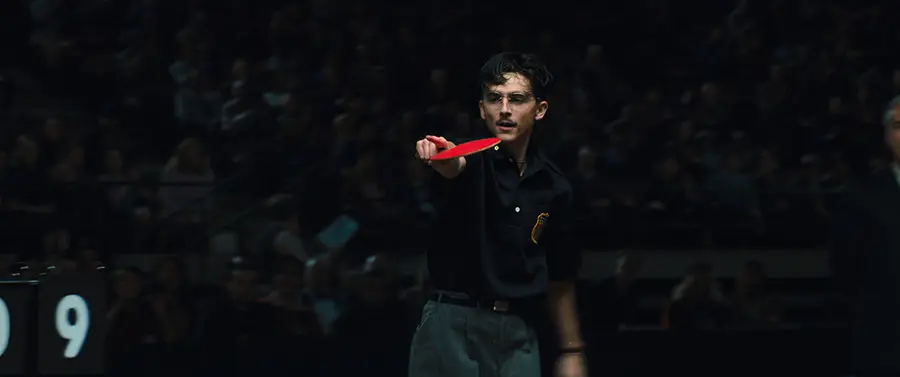
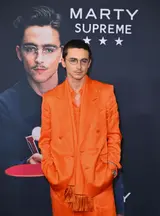
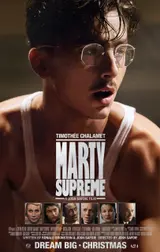
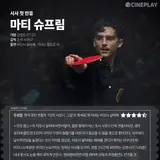
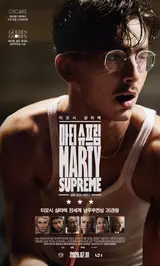
〈Marty Supreme〉 is a table tennis movie. For Korean film fans, the Sharpdy brothers are well known for 〈Heaven Knows What〉(2014), 〈Good Time〉(2017), and 〈Uncut Gems〉(2019), but 〈Marty Supreme〉 is a feature film that older brother Josh Safdie directed on his own for the first time in nearly 10 years. It follows Marty Mauser (Timothée Chalamet), who dreams of turning his life around through table tennis, and the harrowing journey he undertakes—rushing even toward hell—for that dream. Younger brother Benny Safdie, who is also active as an actor, won the Silver Lion at the Venice International Film Festival last year for 〈Smasher Machine〉(2025), which he also directed on his own. The film tells the story of Mark Koo (Dwayne Johnson), a legendary mixed martial arts fighter. Now, Josh and Benny Safdie reportedly plan to direct separately going forward rather than as brothers, and it’s an intriguing coincidence that the movies each made after the so-called split are sports films.
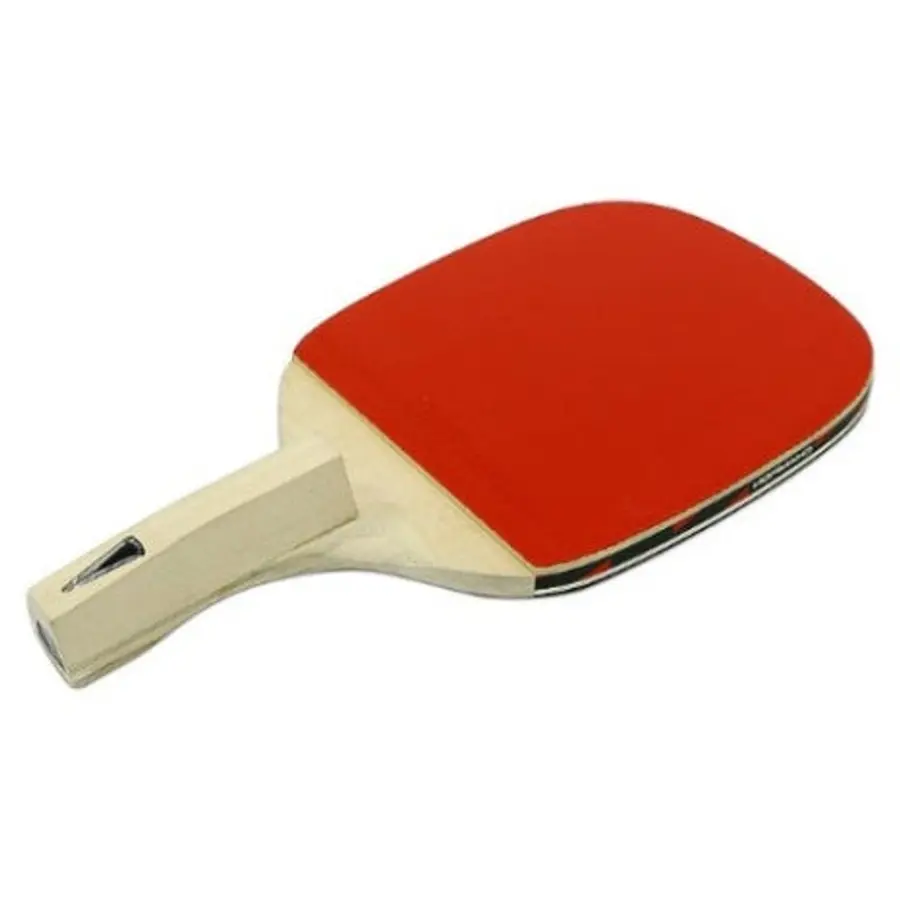
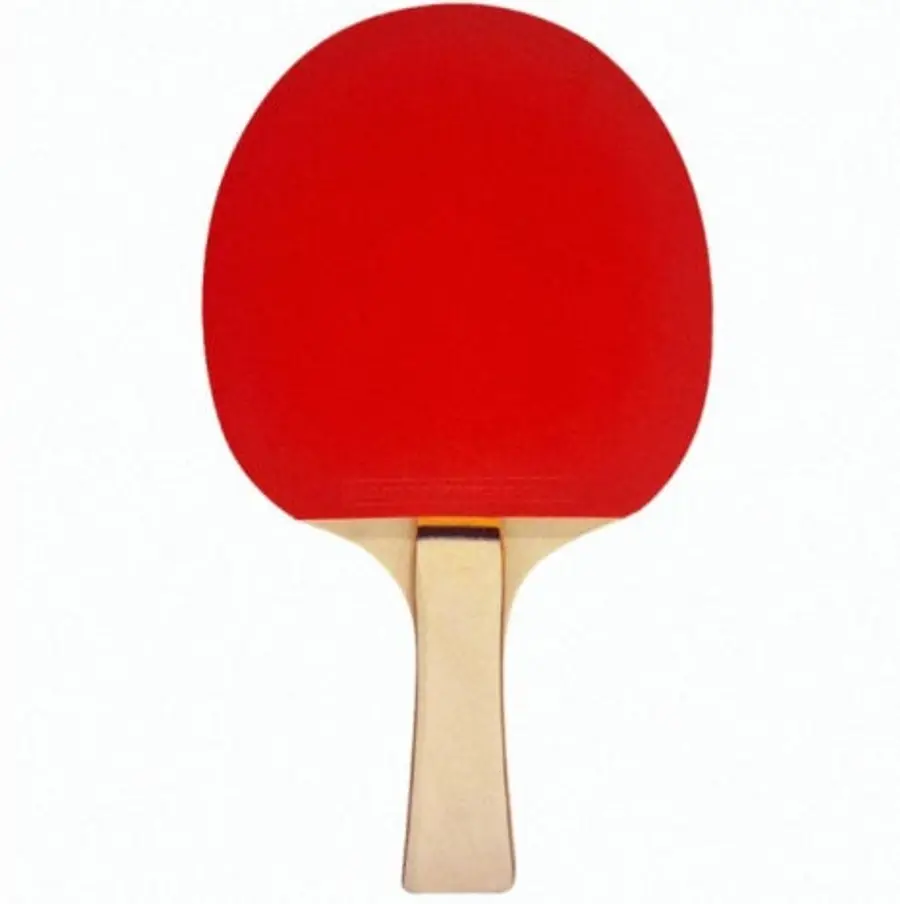
〈Marty Supreme〉 draws tension from an intriguing premise—something that people with an interest in table tennis may not be able to miss: the table tennis racket itself. There are two ways to hold a table tennis racket: penholder (Penholder) and shakehand (Shakehand). Penholder means holding the racket like you hold a pen, while shakehand means holding it like a handshake. With a penholder racket, rubber is attached only on the front side, while shakehand rackets have rubber on both sides. It’s often said that attacking players favor penholders and defensive players prefer shakehand, but in recent international tournaments it’s hard to find penholder players. That’s because using both sides allows shakehand players to have an advantage in backhand stroke motions over penholders, which use just one side. It is said that 90% of table tennis players worldwide are shakehand players. Meanwhile, China—the world’s strongest country in table tennis—developed and uses a Chinese-style penholder that combines the smash advantages of penholding with the stable backhand of shakehand.
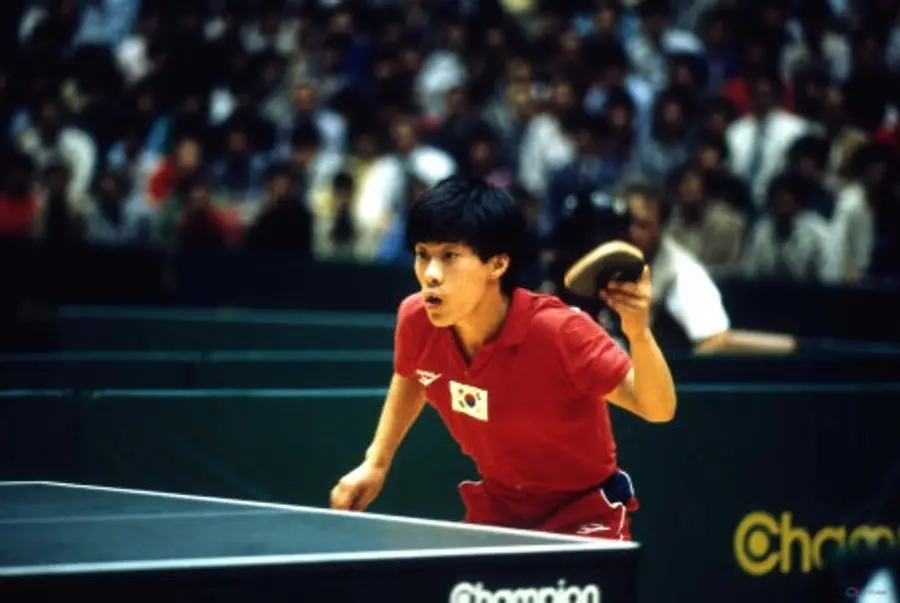
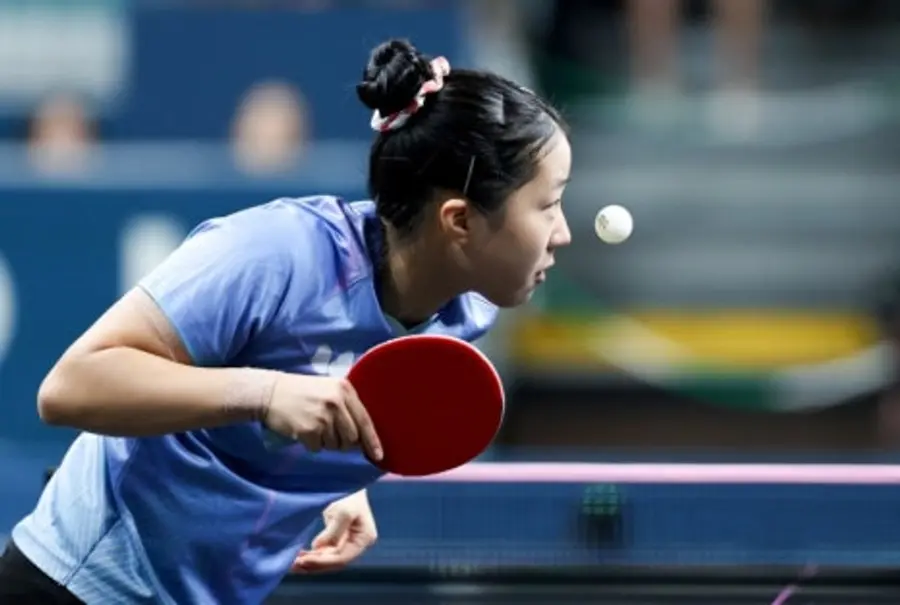
In 〈Marty Supreme〉, Marty Mauser is a shakehand player, while his rival, Japan’s Endo (Kawaguchi Goto), is a penholder. To distinguish him from the Chinese-style penholder, Endo’s penholder is also called a Japanese-style penholder (J-Penholder). Since it has been common in Korea to use the latter, which could be considered a traditional penholder, I found myself pleasantly surprised while watching the film. That’s because, while watching Endo, I couldn’t help but think of Korean player Yoon Nam-gyu. If you’re a Korean who remembers the 1980s, you won’t be able to ignore left-handed penholder Yoon Nam-gyu, who was as quick as they come. The myth began with his table tennis singles gold medal at the 1986 Seoul Asian Games. At the time, his world ranking was No. 50, but he overcame the quarterfinal opponent—Zhang Jia-liang, then the world’s top-ranked player—and surged forward without hesitation to take the gold medal. He was 18 at the time. I still vividly remember the moment when it seemed Zhang Jia-liang would win the quarterfinal match that went to five sets, but Yoon Nam-gyu overcame the score deficit and pulled off a dramatic comeback after trailing 14-19. Maybe 〈Marty Supreme〉 is also reminiscent of Marty Mauser’s thrilling battles (even if the grip is different). Two years later, at the 1988 Seoul Olympics as well, he won gold in the men’s singles and became the first gold medalist in any men’s team ball sport event for South Korea. After that, Yoo Seung-min, who won the men’s singles gold medal at the 2004 Athens Olympics after a 16-year drought, was also a penholder.
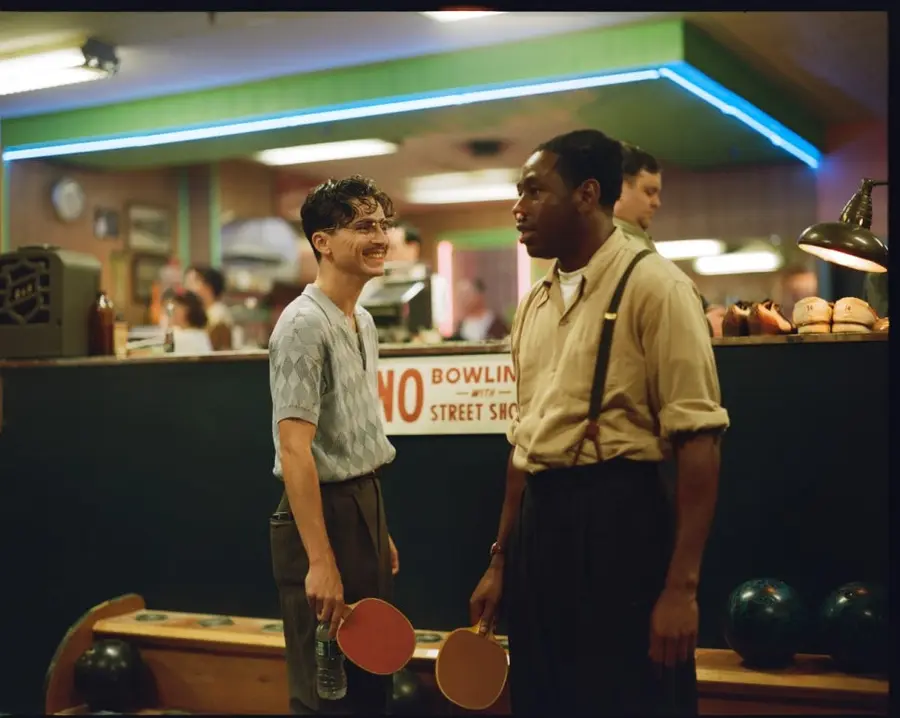
〈Marty Supreme〉 delivers impressive match-scene authenticity—so much so that Timothée Chalamet reportedly practiced only table tennis for months before filming began. Of course, they would have created the motion of the table tennis balls with computer graphics, but you can still feel the amount of training to such a degree that the racket and ball never seem out of sync. The film also builds tension and tension again as the match sees repeated comebacks and reversals, while depicting players who wobble depending on their stamina and mindset—capturing the contrasting characteristics of penholders and shakehand players. For instance, with a penholder, you can use your wrist up to 180 degrees, so on offense you can generate spins with wrist power to produce more forceful shots. Because rubber is attached to only one side of the racket, the racket is lighter, and compared with shakehand you can execute a wider variety of serve types. It’s also easier to make straight, fast shots, which can help you use your opponent’s strength against them more than a shakehand grip. On the other hand, the most lethal downside of a penholder that uses only the front side is a lack of backhand attacking power. In backhand rallies, the situation turns gradually defense-heavy, and that’s when the player starts to get pushed back, leading to greater stamina drain than shakehand. 〈Marty Supreme〉 contains quite a lot of table tennis scenes, and it depicts the relative traits above with remarkable precision, so there’s no time to be bored—you can enjoy the match scenes nonstop. Since each country develops its own method and uses it, it would be understandable if shakehand Marty Mauser, who struggles against penholder Endo (Kawaguchi Goto), tells the referee, “Isn’t it a foul to hold it like that?” even if he’s just raising the question.
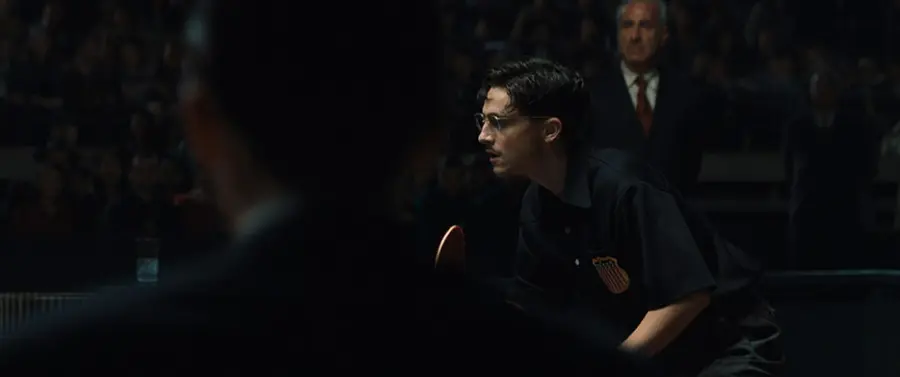
But in 〈Marty Supreme〉, the distinction between penholder and shakehand isn’t just there to make the table tennis scenes more entertaining. Milton Rockwell (Kevin O’Leary), a businessman and husband of Kay Stone (Guinness Paltrow), is making an offer Marty Mauser can’t refuse. He says he has a painful memory: his son was killed by Japanese troops in World War II. But as a businessman who needs to sell ballpoint pens to Japan, there’s no way around it—Japan, his son’s nemesis, is still a massive market. So he tries to carry out marketing alongside Marty Mauser, who needs money, using the “penholder” method. Even though he isn’t a table tennis player, he becomes a “penholder enthusiast” rather than a shakehand enthusiast. That’s how the unbridgeable gulf between shakehand Marty Mauser and penholder Milton Rockwell is created. Still, no matter how much he’s a penholder enthusiast, when he swings to hit Marty Mauser on the cheek with a table tennis racket, he grabs the shakehand grip because it’s easier to strike. In the end, human beings move on instinct rather than calculation.
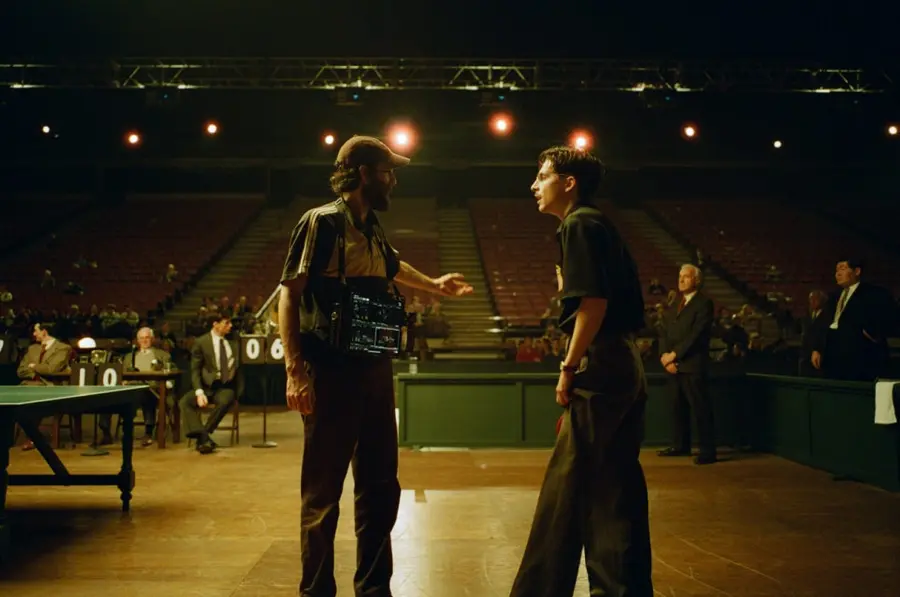
In 〈Marty Supreme〉, Marty Mauser comes from the same roots as Connie in 〈Good Time〉 (Robert Pattinson) and Howard Ratner in 〈Uncut Gems〉 (Adam Sandler). He’s like a kid—unruly, he lies without a second thought, and ultimately he can’t see even the future right in front of him. All three share the fact that they’re constantly being chased. But decisively, Marty Mauser is an officially known, widely recognized famous table tennis player—unlike Connie, who’s a “bum,” or Howard Ratner, who’s a “jeweler.” Like in earlier works, within a narrative that plays out with urgency in real time over what happens almost in a single night, there’s a fixed match schedule and even flights he must check in for. Amid that kind of frantic journey, you still wonder why there are so many people who end up “finding out” things. That’s also why 〈Marty Supreme〉 is more breathless and more perilous than 〈Good Time〉 or 〈Uncut Gems〉—it’s right there.
An actor’s usage manual for over-reading the meaning of objects in films, kicking off “Joo Sung-cheol’s Locker,” and expecting a breakout—“Kim Ji-yeon’s Jewel Case,” a film-music listening room that moved me, “Choo A-young’s Music Box,” and even a purchase log for subculture junkies, “Seong Chan-eol’s Comic Book.” Cineplay reporters will start a biweekly column, each bringing their own tastes and viewpoints.
![[Joo Seong-cheol's Locker] The Black Speaker of 'Sirat' and the Monolith of '2001: A Space Odyssey'](https://cdn.www.cineplay.co.kr/w400/q75/article-images/2026-02-23/01816f3a-b433-4072-887b-e760357e6cc7.jpg)
![[Joo Seong-cheol's Locker] The 'Canned Cart Camera' that Changed the History of World Cinema with 'Nouvelle Vague'](https://cdn.www.cineplay.co.kr/w400/q75/article-images/2026-01-27/563f1a4c-20b8-460b-8523-f31511911bd5.jpg)
![[Joo Sung-cheol's Locker] Ahn Sung-ki is Born, I am Ahn Sung-ki](https://cdn.www.cineplay.co.kr/w400/q75/article-images/2026-01-13/362be897-34af-4524-9a57-6b9935666a0a.jpg)
![[Jusungcheol’s Locker] Odyssey’s one-eyed giant Cyclops and Ray Harryhausen’s “The Seventh Voyage of Sinbad”](https://cdn.www.cineplay.co.kr/w400/q75/article-images/2026-08-10/5faf400e-cf0b-466c-a3d7-31a8bbb38075.jpg)
![[Joo Seong-cheol’s Locker] See ‘Hope’ Again Through the Driver-Grade Cap Joo Seong-cheol Wears While Racing Across Seong-gi Bridge in ‘The Yellow Sea’ and ‘Goksung’](https://cdn.www.cineplay.co.kr/w400/q75/article-images/2026-07-28/7bf74e36-337d-4fd0-8cec-b890f5604345.jpg)
![[Joo Seong-cheol's Locker] The Aesthetics of Jongmyo That Captivated Masters of Martial Arts from Ho Kim-jun to John Woo, Jackie Chan, and Sammo Hung](https://cdn.www.cineplay.co.kr/w400/q75/article-images/2025-12-16/4d8670a7-ef95-4635-8d0c-34313f13dd52.jpg)
![[Joo Seong-cheol's Locker] The King Lear of Korea and Japan, Lee Soon-jae and Nakadai Tatsuya, Two Masters Rest](https://cdn.www.cineplay.co.kr/w400/q75/article-images/2025-12-01/3e753af3-e8d5-41df-83cf-00e9ddfdaae7.jpg)
![[Joo Seong-cheol's Locker] When Trees Comfort Trees, the Cello of 'The Moment the Bell Rings' and 'Can't Help It'](https://cdn.www.cineplay.co.kr/w400/q75/article-images/2025-11-18/52034c54-93dc-4b4c-ac9f-5f9b7946fb23.jpg)
![[Joo Seong-cheol's Locker] What Beer Did Sergio (Benicio Del Toro) Always Carry in 'One Battle After Another'?](https://cdn.www.cineplay.co.kr/w400/q75/article-images/2025-11-04/0794fe08-e847-46a1-ba4c-445f814803a8.jpg)
![[Chu Sung-cheol’s Lockers] Who Spat on Leslie Cheung in “Farewell My Concubine”?](https://cdn.www.cineplay.co.kr/w400/q75/article-images/2026-04-06/7b608cd9-af6c-4c1d-8e87-38c2d2619d55.jpg)
![[Joo Seong-cheol’s Locker] Do You Know the Origin of Woody in “Toy Story”?](https://cdn.www.cineplay.co.kr/w400/q75/article-images/2026-06-16/eb2c5055-d2de-4464-b9e2-eceeca8c7759.jpg)
![[Joo Seong-cheol’s Lockers] Lee Cronin’s The Mummy and Murderous People Season 2 — and a Scorpion Jacket That Feels Like the Rise of Drive](https://cdn.www.cineplay.co.kr/w400/q75/article-images/2026-04-20/1df79cf4-44ef-48e4-a6b4-46f6e35c4eb5.jpg)
![[Joo Seong-cheol's Locker] Tony Leung Sometimes Wants to Hold an Ashtray.](https://cdn.www.cineplay.co.kr/w400/q75/article-images/2026-02-09/8b9ac9f0-6899-4ce2-a562-5594a5b06d61.jpg)
![[Joo Sung-chul's Locker] What Are the Improvised Explosive Devices (IEDs) in 'Warfare' and 'The Hurt Locker'?](https://cdn.www.cineplay.co.kr/w400/q75/article-images/2026-08-24/ae200e60-2be9-478e-8ab4-72a860903979.jpg)
![[Joo Seong-cheol’s Locker] Zombie Things That Don’t Flinch Even When Shot: Korea’s First Zombie Film, “Kwe-si” (1981)](https://cdn.www.cineplay.co.kr/w400/q75/article-images/2026-06-01/26c56ce7-1ddb-46bd-ae67-f71a1ba9e276.jpg)
![[Joo Seong-cheol’s Locker] David’s Stone That Took Down Goliath, “David” All the Way Through](https://cdn.www.cineplay.co.kr/w400/q75/article-images/2026-07-13/524bb041-0e4e-4f59-824b-21d2f7df60a9.jpg)
![[Joo Sung-chul's Locker] If it's hard to visit Cheongnyeongpo of Deposed King Danjong, head to Geumseongdang of Prince Geumseong!](https://cdn.www.cineplay.co.kr/w400/q75/article-images/2026-03-10/7ddd3634-6a13-4eef-870c-e4e6dbcdac04.jpg)
![[Joo Seong-cheol’s Lockers] The Great Dancer Turned Film Director Summoned by “Michael”: Bob Fosse’s “All That Jazz”](https://cdn.www.cineplay.co.kr/w400/q75/article-images/2026-05-18/922af142-be9f-4f1c-98d1-4a7a6667943c.jpg)





![[Joo Seong-cheol’s Lockers] Lee Cronin’s The Mummy and Murderous People Season 2 — and a Scorpion Jacket That Feels Like the Rise of Drive](https://cdn.www.cineplay.co.kr/w160/q75/article-images/2026-04-20/61eadb57-0a15-4f1a-9ef0-70e6bdc5604d.jpg)
![[Joo Seong-cheol’s Lockers] The Great Dancer Turned Film Director Summoned by “Michael”: Bob Fosse’s “All That Jazz”](https://cdn.www.cineplay.co.kr/w160/q75/article-images/2026-05-18/3a98b606-b896-4edb-87a4-a91d1e4f9b95.jpg)

![[Joo Seong-cheol’s Locker] Zombie Things That Don’t Flinch Even When Shot: Korea’s First Zombie Film, “Kwe-si” (1981)](https://cdn.www.cineplay.co.kr/w160/q75/article-images/2026-06-01/7b0631d6-0145-48fc-912a-135c182553cf.jpg)
![[Joo Seong-cheol’s Locker] Do You Know the Origin of Woody in “Toy Story”?](https://cdn.www.cineplay.co.kr/w160/q75/article-images/2026-06-16/dab26609-a71b-403b-917e-b99ff185949c.jpg)


![[Seong Chan-eol’s Comic Books] She Lied Her Way Into the School Heartthrob’s Engagement in 〈The Glory of Yuriko the Liar〉](https://cdn.www.cineplay.co.kr/w160/q75/article-images/2026-07-02/6803c06c-f9bd-42f1-a50b-2fce2c351c70.jpg)
댓글 (0)
댓글 작성
댓글을 작성하려면 로그인이 필요합니다.
로그인하기