



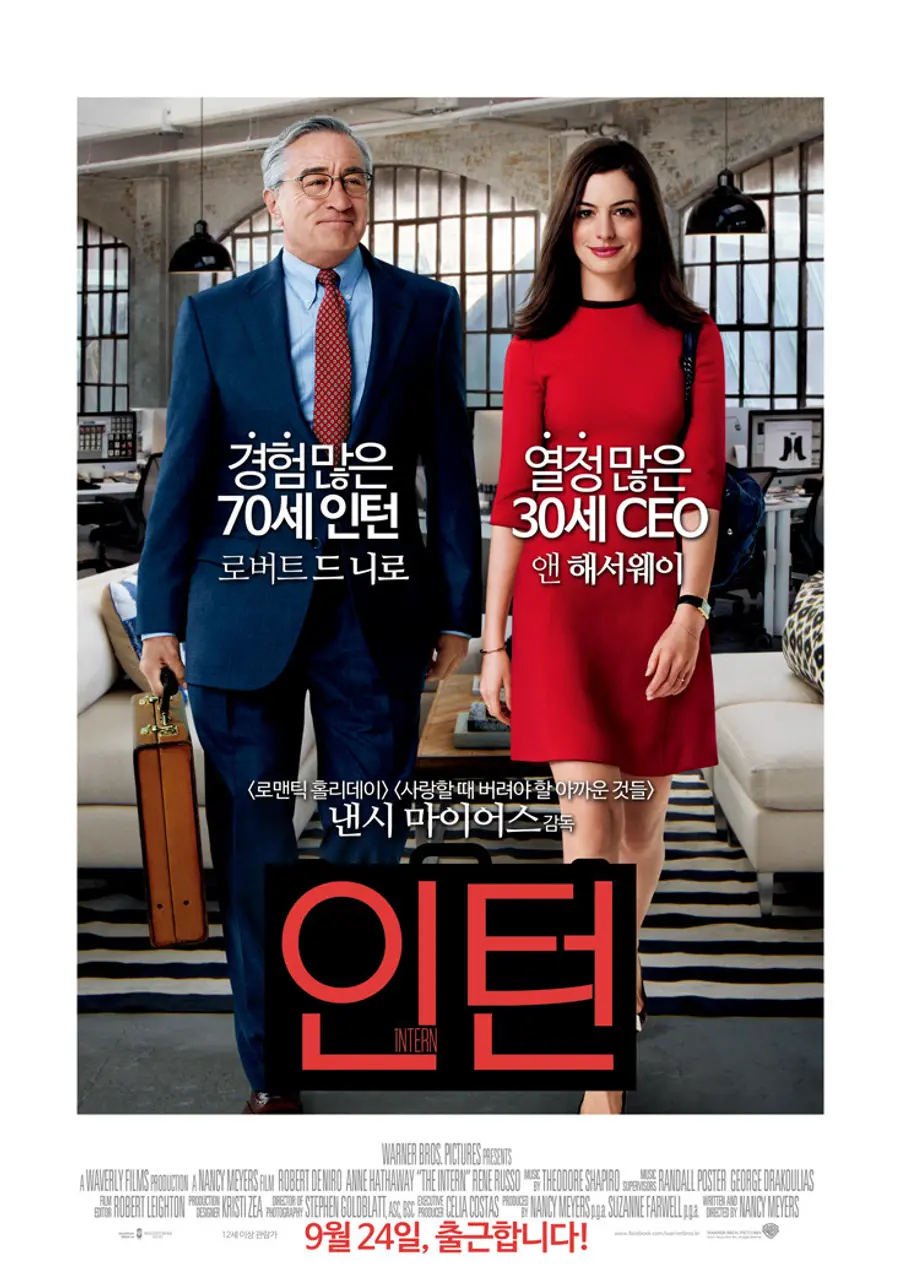
“Back in action.” In Nancy Meyers’ 〈The Intern〉 (2015), Ben (Robert De Niro) says to himself as he prepares for his first day back at work. The expression describes resuming activity after an extended break because of rest or an injury. Strictly speaking, however, he is not talking to himself. He is greeting the briefcase that, after a long absence, is also heading back to work with him. Ben, 70, retired from a publishing company where he worked for more than 40 years. After losing his wife, he traveled and studied foreign languages before landing a spot in the senior internship program at About the Fit, a fashion company, and beginning a new job.
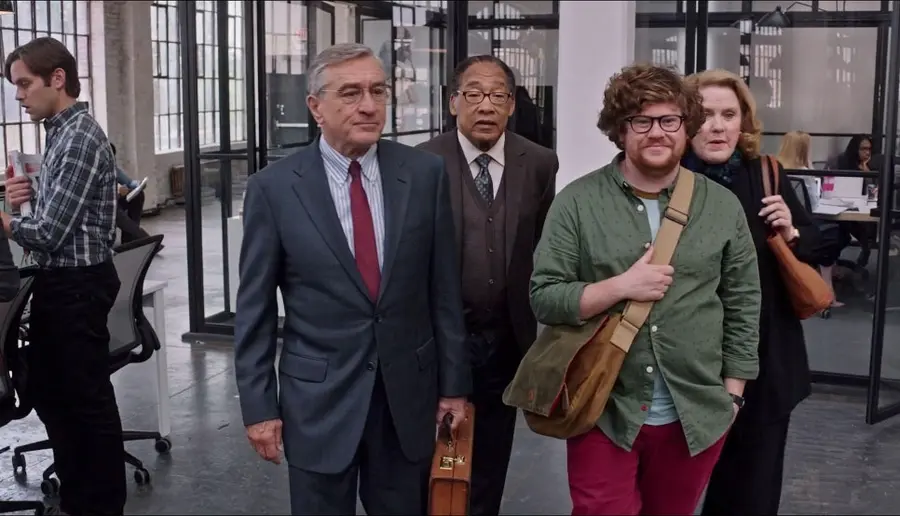
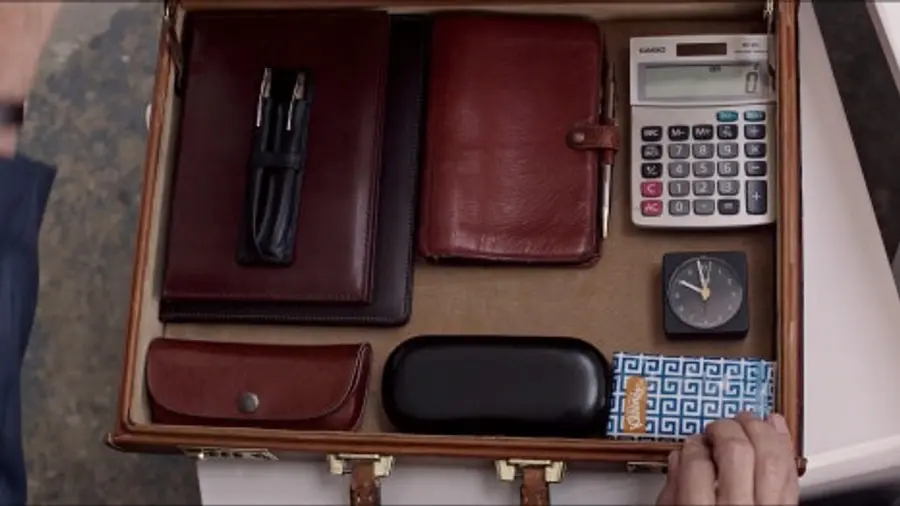
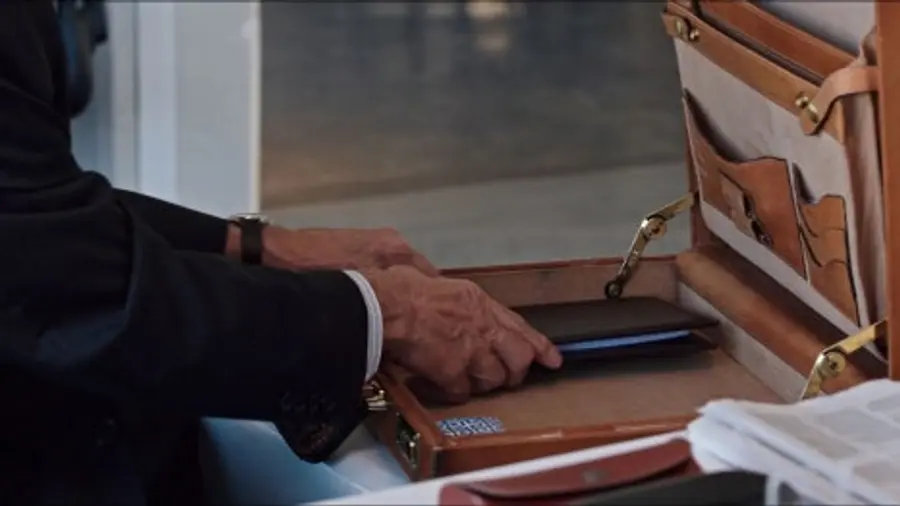
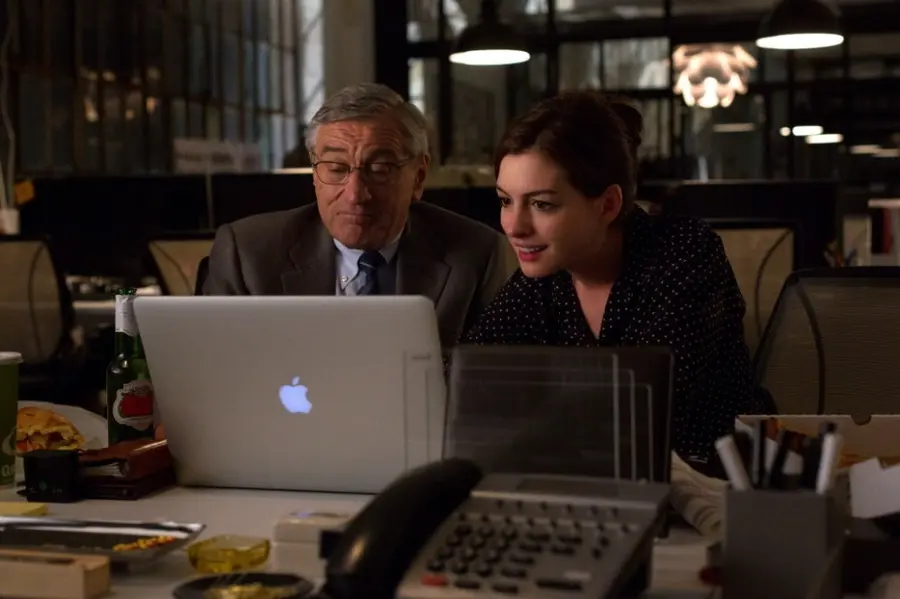
The most striking object in 〈The Intern〉 is the dark brown, well-worn leather briefcase that returns to the commute with Ben. It appears on the movie’s poster, and there is even a poster devoted to the bag alone. You could call it a contrast between the digital and the analog. Davis (Zack Pearlman), who works beside Ben as a fellow intern, carries a bag filled with a smartphone, chargers, USB drives and a multi-cable connector. Ben’s leather briefcase contains an eyeglass case, a fountain-pen set, a calculator, a Samsung flip phone, a paper newspaper and a small travel clock. When a colleague admires the briefcase, Ben identifies it as a “1973 Executive Ashburn Attaché” and says, “They don’t make it anymore.” Ben worked for more than 40 years at a company that published phone books, including 20 years as its vice president of sales and advertising. The briefcase is therefore much like a longtime colleague that has been through everything with him. Old but intact, it is a classic among classics that has never lost its usefulness over the years. The same is true of Ben.
In films Nancy Meyers wrote and directed, including 〈Father of the Bride〉 (1991), 〈What Women Want〉 (2000), 〈Something’s Gotta Give〉 (2003), 〈The Holiday〉 (2006) and 〈It’s Complicated〉 (2009), she established herself as one of Hollywood’s leading romantic-comedy specialists. For Meyers, Ben’s handkerchief is as precious as his leather briefcase. Davis cannot understand why Ben carries a clean, pressed white handkerchief every day. When Davis asks, “Why do you carry that handkerchief?” Ben replies that it is not for his own use but “to lend to someone else.” It may be the last vestige of a gentleman’s manners, now slowly disappearing. When Becky (Cristina Scherer), Jules’ (Anne Hathaway) personal assistant, bursts into tears, Ben sends the handkerchief to her through another colleague. The scene shows that, with some objects, how they are used matters more than why they are owned.
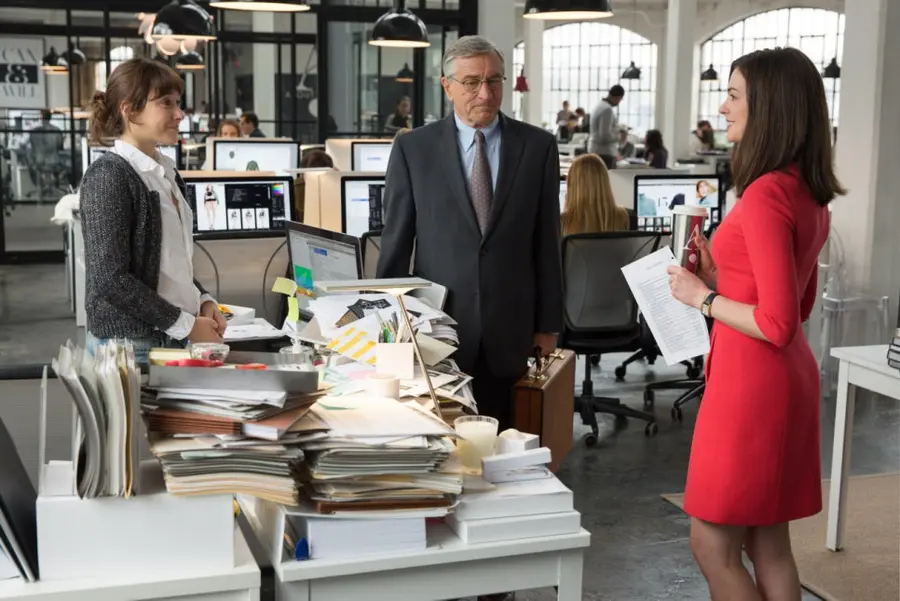
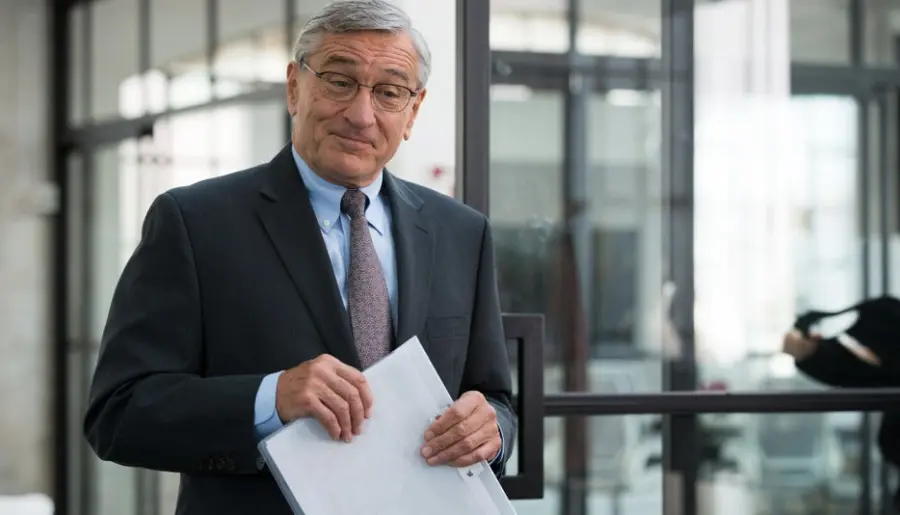
Ben’s clothes matter, too. When Jules tells him he does not need to dress up for work, Ben replies, “I’m comfortable in a suit.” He is not trying to impress anyone at his new job, nor is he clinging to the past. This is simply the most natural version of himself. Just as the briefcase made in 1973 looks almost like something a hipster would carry, the neatly pressed shirts, ties and immaculate suits become part of Ben’s individuality. His home wardrobe, accumulated over decades, is essentially a treasure trove. Jules has grown the company at an extraordinary pace but is constantly pressed for time, short on sleep and perpetually rattled, even accidentally sending emails to the wrong recipients. Ben, by contrast, remains at his post with the same relaxed expression.
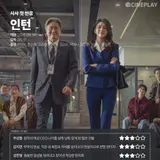
Those elements do not emerge as clearly in the recently remade Korean film 〈The Intern〉, but one can find an academic paper devoted entirely to Ben’s objects in Nancy Meyers’ 〈The Intern〉. In “Business Suits, Briefcases and Handkerchiefs: The Material Culture of Retro-Masculinity in 〈The Intern〉,” Allison Bartlett analyzes how Meyers avoids making a joke of “a septuagenarian intern who goes to work carrying an old briefcase” and instead shows “how he reveals his tastes and way of life, instantly making himself look like a hipster.” At the same time, Ben’s suit, briefcase and handkerchief represent the possessions of successful American middle-class male office workers of an earlier era. Companies then were far more male-dominated spaces, closed off to women. In the film, Jules meets mostly male candidates while searching for a new CEO, and she encounters sexist comments and behavior. Ben is, in fact, much older than any of them. Through Ben, Meyers does not merely evoke retro charm. She shows the dignity of a classic naturally joining the current of change. It is a clear example of how Nancy Meyers’ mature mastery reveals itself in ways beyond her direction.
Ben’s leather briefcase is a business bag of the kind used by American professionals in the 1960s and 1970s. It has a rigid rectangular frame, brass-colored clasps and a short leather handle. It is a hard-case bag that never loses its shape. The line about its having been made in 1973 is important. Ben is 70 in the film, which is set in 2015, so he probably bought the bag when he was 28. He also says he worked at the publishing company for more than 40 years, suggesting that he likely purchased it when he was settling into that company rather than when he was a novice just starting his career. We do not know whether it was a gift or something he bought himself, but it must have been a companion throughout his years at the publishing company, perhaps from the moment he decided it would be his lifelong workplace.
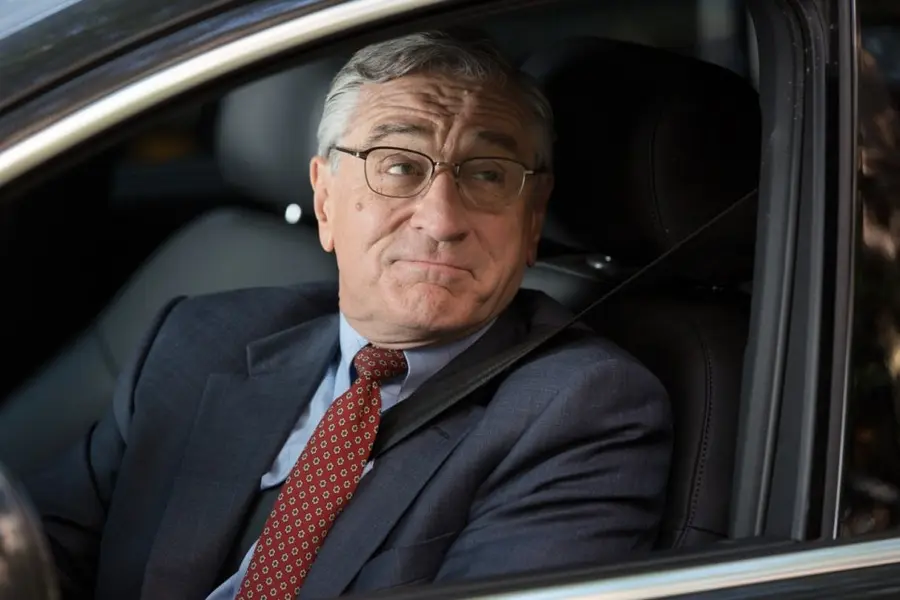
Another important point is the intriguing contrast between the movie’s title, 〈The Intern〉, and the bag’s name, “Executive Ashburn Attaché.” “Executive” means a company officer. Ben once carried that bag while working as an executive; now he has become an intern, the lowest-ranking employee. It is a perfectly calibrated paradox: an intern carrying an executive’s briefcase. And, as the film reveals near the end, the company operates in a remodeled building that once housed the publishing company where Ben worked. Ben and his briefcase are returning to work in a changed company — and, more broadly, a changed world. The briefcase has gone back to its old workplace, too. It is an exquisite and beautiful way to give an object a life of its own.
Beginning with “Joo Sung-chul’s Locker,” an overinterpretation of objects in movies, Cineplay reporters are launching biweekly columns shaped by their individual tastes and perspectives: “Kim Ji-yeon’s Jewelry Box,” a user’s guide to actors expected to reach new heights; “Chua Young’s Music Box,” a listening room for film scores that moved me; and “Sung Chan-eol’s Comic Book,” a buying diary from a dealer in subculture ephemera.
![[Joo Seong-cheol's Locker] The Black Speaker of 'Sirat' and the Monolith of '2001: A Space Odyssey'](https://cdn.www.cineplay.co.kr/w400/q75/article-images/2026-02-23/01816f3a-b433-4072-887b-e760357e6cc7.jpg)
![[Joo Seong-cheol's Locker] The 'Canned Cart Camera' that Changed the History of World Cinema with 'Nouvelle Vague'](https://cdn.www.cineplay.co.kr/w400/q75/article-images/2026-01-27/563f1a4c-20b8-460b-8523-f31511911bd5.jpg)
![[Joo Sung-cheol's Locker] Ahn Sung-ki is Born, I am Ahn Sung-ki](https://cdn.www.cineplay.co.kr/w400/q75/article-images/2026-01-13/362be897-34af-4524-9a57-6b9935666a0a.jpg)
![[Jusungcheol’s Locker] Odyssey’s one-eyed giant Cyclops and Ray Harryhausen’s “The Seventh Voyage of Sinbad”](https://cdn.www.cineplay.co.kr/w400/q75/article-images/2026-08-10/5faf400e-cf0b-466c-a3d7-31a8bbb38075.jpg)
![[Joo Seong-cheol’s Locker] See ‘Hope’ Again Through the Driver-Grade Cap Joo Seong-cheol Wears While Racing Across Seong-gi Bridge in ‘The Yellow Sea’ and ‘Goksung’](https://cdn.www.cineplay.co.kr/w400/q75/article-images/2026-07-28/7bf74e36-337d-4fd0-8cec-b890f5604345.jpg)
![[Joo Sung-cheol’s Locker] Watching “Marty Supreme,” Recalling Yoon Nam-gyu’s Penholder Table Tennis Racket](https://cdn.www.cineplay.co.kr/w400/q75/article-images/2026-06-29/0dc02383-0dc9-4ea1-9de5-f1eaffbeb9b9.jpg)
![[Joo Seong-cheol's Locker] The Aesthetics of Jongmyo That Captivated Masters of Martial Arts from Ho Kim-jun to John Woo, Jackie Chan, and Sammo Hung](https://cdn.www.cineplay.co.kr/w400/q75/article-images/2025-12-16/4d8670a7-ef95-4635-8d0c-34313f13dd52.jpg)
![[Joo Seong-cheol's Locker] The King Lear of Korea and Japan, Lee Soon-jae and Nakadai Tatsuya, Two Masters Rest](https://cdn.www.cineplay.co.kr/w400/q75/article-images/2025-12-01/3e753af3-e8d5-41df-83cf-00e9ddfdaae7.jpg)
![[Joo Seong-cheol's Locker] When Trees Comfort Trees, the Cello of 'The Moment the Bell Rings' and 'Can't Help It'](https://cdn.www.cineplay.co.kr/w400/q75/article-images/2025-11-18/52034c54-93dc-4b4c-ac9f-5f9b7946fb23.jpg)
![[Joo Seong-cheol's Locker] What Beer Did Sergio (Benicio Del Toro) Always Carry in 'One Battle After Another'?](https://cdn.www.cineplay.co.kr/w400/q75/article-images/2025-11-04/0794fe08-e847-46a1-ba4c-445f814803a8.jpg)
![[Joo Seong-cheol’s Locker] Do You Know the Origin of Woody in “Toy Story”?](https://cdn.www.cineplay.co.kr/w400/q75/article-images/2026-06-16/eb2c5055-d2de-4464-b9e2-eceeca8c7759.jpg)
![[Joo Sung-chul’s Locker] The Still-Enchanting Mambo Dance in the 4K Re-release of *Days of Being Wild*—Leslie Cheung and the Mirror](https://cdn.www.cineplay.co.kr/w400/q75/article-images/2026-10-20/5aada822-27d2-4109-bf79-e39610f84941.jpg)
![[Chu Sung-cheol’s Lockers] Who Spat on Leslie Cheung in “Farewell My Concubine”?](https://cdn.www.cineplay.co.kr/w400/q75/article-images/2026-04-06/7b608cd9-af6c-4c1d-8e87-38c2d2619d55.jpg)
![[Joo Seong-cheol's Locker] Tony Leung Sometimes Wants to Hold an Ashtray.](https://cdn.www.cineplay.co.kr/w400/q75/article-images/2026-02-09/8b9ac9f0-6899-4ce2-a562-5594a5b06d61.jpg)
![[Joo Sung-chul's Locker] What Are the Improvised Explosive Devices (IEDs) in 'Warfare' and 'The Hurt Locker'?](https://cdn.www.cineplay.co.kr/w400/q75/article-images/2026-08-24/ae200e60-2be9-478e-8ab4-72a860903979.jpg)
![[Joo Seong-cheol’s Locker] Zombie Things That Don’t Flinch Even When Shot: Korea’s First Zombie Film, “Kwe-si” (1981)](https://cdn.www.cineplay.co.kr/w400/q75/article-images/2026-06-01/26c56ce7-1ddb-46bd-ae67-f71a1ba9e276.jpg)

![[Joo Seong-cheol’s Locker] David’s Stone That Took Down Goliath, “David” All the Way Through](https://cdn.www.cineplay.co.kr/w400/q75/article-images/2026-07-13/524bb041-0e4e-4f59-824b-21d2f7df60a9.jpg)
![[Joo Sung-chul's Locker] If it's hard to visit Cheongnyeongpo of Deposed King Danjong, head to Geumseongdang of Prince Geumseong!](https://cdn.www.cineplay.co.kr/w400/q75/article-images/2026-03-10/7ddd3634-6a13-4eef-870c-e4e6dbcdac04.jpg)
![[Joo Seong-cheol’s Lockers] The Great Dancer Turned Film Director Summoned by “Michael”: Bob Fosse’s “All That Jazz”](https://cdn.www.cineplay.co.kr/w400/q75/article-images/2026-05-18/922af142-be9f-4f1c-98d1-4a7a6667943c.jpg)
![[Joo Seong-cheol’s Lockers] Lee Cronin’s The Mummy and Murderous People Season 2 — and a Scorpion Jacket That Feels Like the Rise of Drive](https://cdn.www.cineplay.co.kr/w400/q75/article-images/2026-04-20/1df79cf4-44ef-48e4-a6b4-46f6e35c4eb5.jpg)

![[Film Festival] Picks from the 16th Seoul International PRIDE Film Festival, Part 2: ‘Asia Pride’ and ‘Special Pride’ Sections, ‘Korean Queer Film History’](https://cdn.www.cineplay.co.kr/w300/q75/article-images/2026-10-22/15a212f0-a3f9-48c8-b0fc-c12c11aeaa26.jpg)
![[Film Festival] 16th Seoul International PRIDE Film Festival: Five Picks ① — “Open Pride” Section: “Transgender People Take Center Stage”](https://cdn.www.cineplay.co.kr/w300/q75/article-images/2026-10-22/e9f25e0a-49ca-44e2-b521-0a67bb3814e2.jpg)








댓글 (0)
댓글 작성
댓글을 작성하려면 로그인이 필요합니다.
로그인하기